
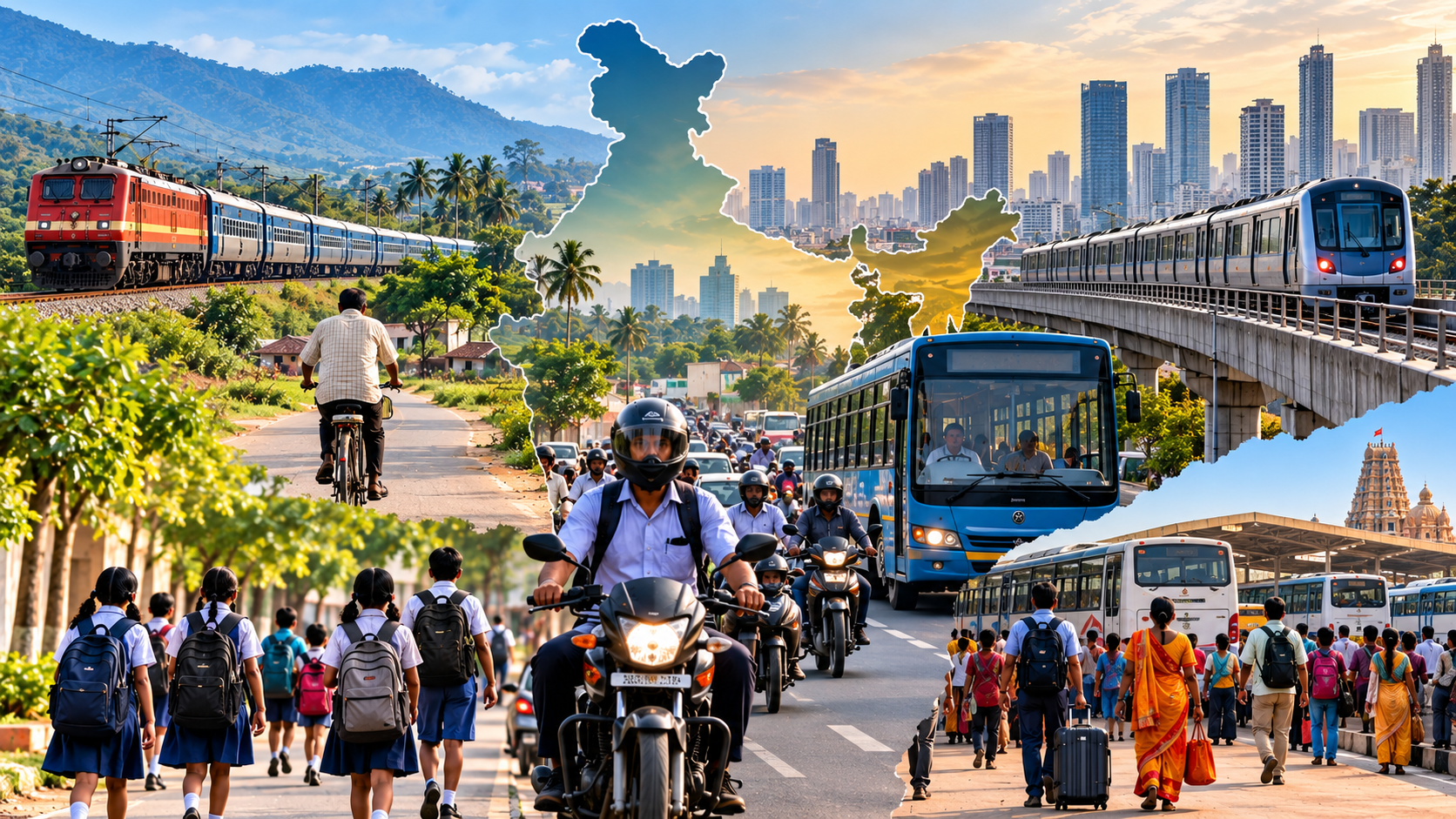
For the first time, a nationwide picture of how Indians travel to schools, colleges, workplaces, markets, religious places and social gatherings has emerged. The National Household Travel Survey 2025-26 conducted by the National Statistical Office (NSO) provides a detailed picture of India’s everyday mobility. The survey shows not only which modes of transport people use, but also how long their journeys take and how much they spend on travelling.
The importance of these findings goes beyond understanding India’s transport system. Transport is closely linked to energy consumption, air pollution and greenhouse gas emissions. Understanding how people travel is therefore essential to assessing how sustainable India’s mobility system is and how it can move towards a lower-carbon future.
The findings present an interesting picture. Among people travelling to work, 42.6 percent use two-wheelers as their primary mode. For overnight household journeys, buses account for 55.8 percent while railways account for 17.7 percent. Among students, walking is the most common mode at 37 percent, followed by buses at 29.5 percent.
India’s mobility story therefore presents two contrasting realities. On one side are walking, cycling, buses and railways, which can support relatively low-carbon mobility. On the other is the growing dependence on two-wheelers, particularly among the urban working population. This contrast is critical for India’s future clean mobility and climate strategy.
For the First Time, India Gets a Comprehensive Picture of Household Travel
The National Statistical Office, under the Ministry of Statistics and Programme Implementation, conducted India’s first nationwide Household Travel Survey between July 2025 and June 2026. The survey covered 14,274 villages and 10,377 urban blocks, collecting information from 4,92,023 households and 20,34,371 people.
Journeys of one kilometre or more were recorded as travel. The survey examined factors such as the purpose of travel, the mode of transport used, travel time and expenditure.
The data provides an important national baseline for planning transport routes, improving public transport access and guiding infrastructure investment.
From an environmental perspective, however, the survey raises another important question: how sustainable is India’s everyday mobility?
Two-Wheelers Dominate Work Commutes
One of the most significant findings is that 42.6 percent of people travelling to fixed or non-fixed workplaces use a two-wheeler as their primary mode of transport. The share rises to 52.3 percent in urban India, while 37.1 percent of rural workers use two-wheelers.
Overall, 28.3 percent of workers walk to work, 42.6 percent use two-wheelers, 10.7 percent use bicycles, 6.7 percent use buses, 6.4 percent use auto-rickshaws, 3 percent use cars and 2.1 percent use trains, metros, monorails or trams.
This has major implications for India’s transport future. According to NITI Aayog, the transport sector contributes around 12 percent of India’s energy-related CO₂ emissions, while road transport accounts for more than 92 percent of emissions within the transport sector. Road transport is also an important contributor to urban air pollution.
The high share of two-wheelers therefore reflects both the need for affordable and flexible mobility and the challenge of shifting from petrol-based transport towards cleaner mobility.
The Solution to Two-Wheeler Dependence Is Not Simply Asking People to Give Up Vehicles
Two-wheelers are popular in India for several practical reasons. They are relatively affordable compared with cars, easier to use on congested roads and often provide mobility where public transport options are limited.
This means a sustainable mobility strategy cannot succeed simply by asking people to stop using private vehicles.
Affordable and frequent public transport, safe walking infrastructure and proper cycling networks will be essential. Where private vehicles remain necessary, the transition towards electric mobility and cleaner technologies will also matter.
India therefore needs both electrification and a shift towards more sustainable modes. People need reliable alternatives such as buses, metro systems, railways, walking and cycling if private vehicle dependence is to decline over time.
Walking Is the Biggest Green Mobility Option for Students
The survey presents a relatively positive environmental picture when it comes to student travel. Among students travelling to schools and basic-course educational institutions, 37 percent walk, 29.5 percent use buses, 15.8 percent cycle, 10.5 percent use auto-rickshaws and 6.7 percent use two-wheelers.
This means walking and cycling already account for a significant share of student mobility.
The finding has important implications for urban planning. If schools, colleges and residential neighbourhoods are connected through safe pedestrian and cycling networks, many short-distance motorised trips could be avoided.
According to the survey, 87.6 percent of students reach their educational institutions within 30 minutes. The average journey takes around 23 minutes.
This suggests that a large share of education-related trips are within a distance where better pedestrian and cycling infrastructure could support low-emission mobility.
Most People Reach Their Destination Within 30 Minutes, but Urban Commutes Cost More
According to the survey, 83.4 percent of workers reach their fixed workplace in less than 30 minutes.
There is, however, a difference between rural and urban India. The average travel time for rural workers is around 23 minutes, compared with about 27 minutes for urban workers.
The economic cost of commuting is another important factor. The average monthly expenditure on commuting to work is around ₹785 per worker. In urban areas, this rises to ₹1,044, while the average expenditure in rural areas is around ₹612.
This shows that mobility is not simply an environmental issue. It is also closely connected to household finances and affordability.
Future green mobility policies therefore need to reduce pollution and emissions while also making daily travel more affordable.
Buses and Railways Demonstrate the Potential of Public Transport
For overnight household journeys, buses account for 55.8 percent and inter-city railways for 17.7 percent. Together, these two modes account for nearly three-quarters of such journeys.
This highlights the strength of India’s public transport network, particularly for long-distance travel.
From an environmental perspective, the importance of mass transit lies in its ability to move large numbers of people through a single journey. Compared with private vehicles, public transport can handle travel demand more efficiently on a per-passenger basis.
This is why strengthening public transport remains important for both climate policy and air-quality strategies.
Social and Religious Activities Drive More Overnight Travel Than Tourism
One of the more interesting findings of the survey is that tourism is not the primary reason for overnight travel.
Around 70.2 percent of overnight household trips are related to socialising, communication and religious activities. In comparison, culture, leisure, sports and tourism account for 7.4 percent.
This highlights the social nature of travel demand in India. Long-distance travel is not only about tourism. Families, relatives, social relationships and religious activities are major reasons why people travel.
Sustainable inter-city mobility therefore cannot be designed only around tourist corridors. The availability of buses and trains is important for both social mobility and environmental sustainability.
Metro and Mass Transit Are Becoming Increasingly Important in Urban India
Trains, monorails and trams account for 2.1 percent of total workforce commuting, but their share rises to around 5 percent in urban areas.
The share is considerably higher in some states. Maharashtra records 20.7 percent, West Bengal 16.5 percent and Delhi 14.4 percent.
These figures indicate that where high-capacity public transport is available, people use it.
However, building metro lines alone is not enough. Last-mile connectivity, affordable fares, pedestrian infrastructure and integration with bus networks are equally important.
If reaching a metro station is difficult, feeder buses are unavailable or pedestrian routes are unsafe, the full environmental benefits of mass transit cannot be realised.
Mobility and Air Pollution Are Closely Connected
The environmental impact of transport in India is not limited to carbon dioxide emissions. Petrol and diesel vehicles also release particulate matter, nitrogen oxides and other pollutants.
Road transport therefore affects both climate change and urban air quality.
Delhi-NCR provides a clear example, where vehicular emissions are considered an important contributor to the region’s air pollution problem. Millions of daily journeys therefore have the potential to influence the quality of urban air depending on which modes of transport people use.
The Household Travel Survey should consequently not be viewed simply as a set of transportation statistics. It provides a picture of the mobility demand being generated every day across India’s cities and villages and offers clues about its potential environmental footprint.
If 42.6 Percent of Workers Use Two-Wheelers, the EV Transition Could Be Significant
The large share of two-wheelers is certainly a challenge, but it can also create an opportunity for reducing transport emissions.
If a significant proportion of commuters already depend on two-wheelers, expanding electric two-wheelers could play an important role in reducing emissions from daily travel.
However, simply replacing petrol scooters with electric scooters is not the complete definition of sustainable mobility.
If the total number of private vehicles on roads continues to rise, problems such as congestion, demand for road space, tyre and brake wear and infrastructure pressure will remain.
A stronger model would combine walking, cycling, buses, metro systems, railways, shared mobility and electric vehicles within an integrated transport system.
Electrification needs to happen alongside a shift towards public and non-motorised transport.
Women’s Mobility Is Also an Important Part of Sustainable Transport Planning
The survey also highlights a gender gap in workforce mobility. Across the country, 61.9 percent of male workers made daily work trips of more than one kilometre, compared with 41.9 percent of female workers.
This difference cannot be explained simply by transport availability. Employment patterns, unpaid domestic work, caregiving responsibilities, safety, social norms and workplace locations can all influence women’s mobility.
Safe, reliable and affordable public transport can help expand women’s mobility while potentially reducing dependence on private vehicles.
Gender-responsive transport planning should therefore be considered an important part of sustainable mobility.
Short Travel Times Alone Do Not Make a Mobility System Sustainable
The fact that most people reach schools or workplaces within 30 minutes is encouraging, but travel time alone does not determine whether a transport system is environmentally sustainable.
It is also necessary to understand how many people are travelling in petrol and diesel vehicles, how many are using buses and railways, how many short trips could be made on foot or by bicycle, and whether public transport offers adequate frequency and last-mile connectivity.
Future mobility planning will therefore need to combine travel data with environmental indicators. This can help determine whether cities are providing not just faster mobility but cleaner mobility as well.
Why the Survey Matters for India’s Sustainable Mobility Strategy
The biggest contribution of the National Household Travel Survey is that policy makers now have a national baseline for understanding household-level travel behaviour.
The data can help make public transport planning more targeted. Areas with high demand for buses and railways can receive better routes and frequency. Areas with a large share of short-distance trips can be prioritised for footpaths and cycling infrastructure.
Similarly, regions where two-wheelers account for a large share of commuter travel can be targeted for electric two-wheeler adoption and charging infrastructure.
High-demand corridors can also be supported with mass transit to reduce congestion and dependence on private vehicles.
Most importantly, transport policy can now be connected more closely with the mobility behaviour of households on the ground.
The Real Challenge Is Not More Travel, but Better Travel
Mobility demand in India is likely to grow in the coming years. Urbanisation, employment, education, economic activity and tourism will all increase the need for people to travel.
The question, therefore, is not whether people should travel.
The real question is how India can give people the ability to travel with lower pollution, lower costs and lower energy consumption.
The first Household Travel Survey shows that walking, cycling, buses and railways already form important parts of India’s mobility system. At the same time, it makes clear that two-wheelers have become the dominant mode of daily commuting for a large share of the urban workforce.
This provides an important direction for India’s future mobility strategy. The next mobility transformation should not be based only on more roads and more vehicles. It should also focus on better public transport, safer walking and cycling infrastructure, electric mobility, shared transport and integrated urban planning.
Conclusion
The National Household Travel Survey 2025-26 is the first major national snapshot of how Indians travel. Its findings are as important for transportation planners as they are for environmental policy makers.
The fact that 42.6 percent of workers use two-wheelers for their commute reflects the reality of private mobility in India. At the same time, the 55.8 percent share of buses and 17.7 percent share of railways in overnight journeys demonstrate that public transport remains a major part of the country’s mobility system.
The large share of walking and cycling among students also shows that many short-distance journeys can potentially remain low-carbon if safe infrastructure is available.
The next challenge is to turn this data into effective policy.
If India strengthens its bus and rail networks, makes walking and cycling safer and moves private mobility towards cleaner technologies, it can prevent growing transport demand from translating into proportionately higher air pollution and greenhouse gas emissions.
The central environmental message of the survey is therefore clear: India does not simply need more mobility. It needs cleaner, more affordable and more inclusive mobility.
The success of India’s transport system in the coming years will not only be measured by how quickly or how far people can travel, but also by how efficiently they can reach their destinations while keeping costs, energy consumption and environmental impact under control.
Read more such articles on Indian Environmentalism.