
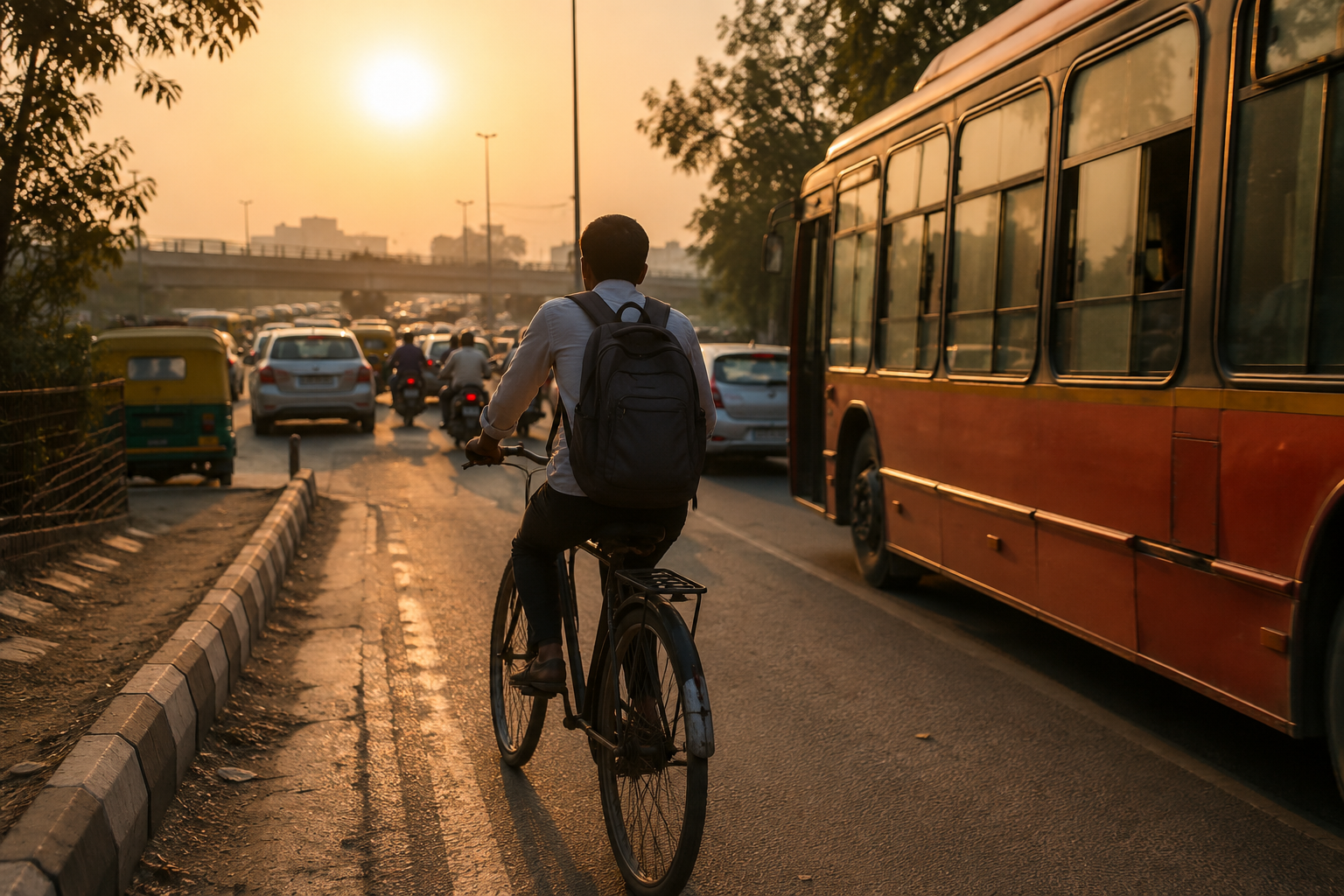
The bicycle has come a long way. Once considered a luxury, cycles were once a familiar sight on Delhi’s streets, their bells ringing through the city with the familiar tring-tring. Today, however, Delhi’s cyclists navigate roads increasingly dominated by motor vehicles, leaving those who still rely on bicycles to navigate a city built largely around cars and two-wheelers. Yet, despite this shift, walking and cycling remain an important part of how Delhi moves.
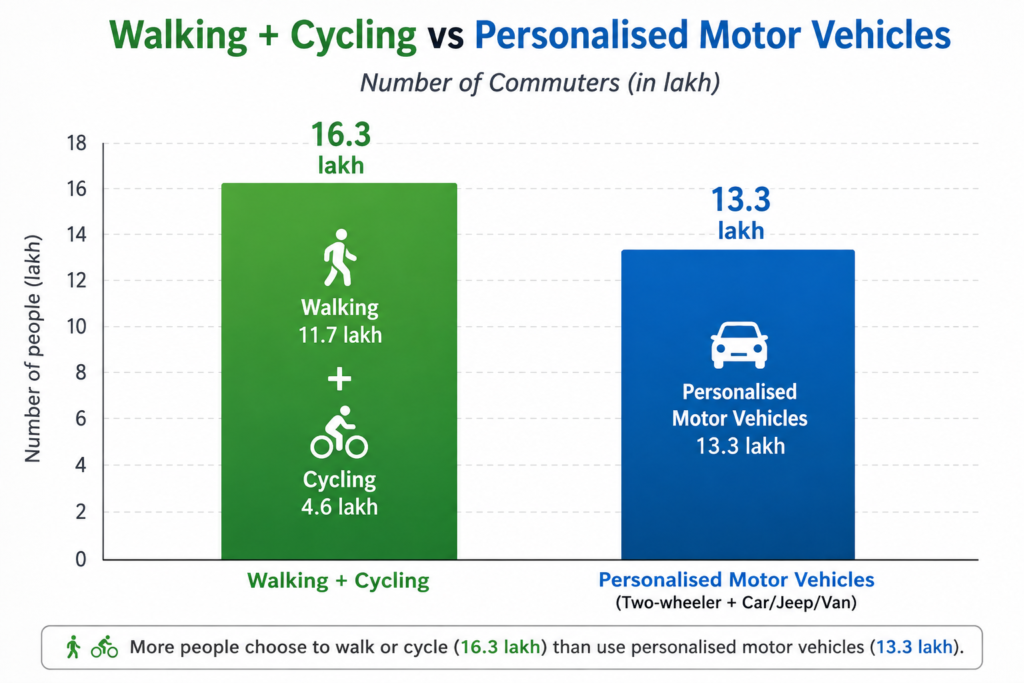
According to the Centre for Science and Environment (CSE), around 11.7 lakh people walk to work every day, while another 4.6 lakh commute by bicycle. Together, that is 16.3 lakh people who travel to work on foot or by cycle. In comparison, around 13.3 lakh people commute using personalised motor vehicles, 7.5 lakh on two-wheelers and 5.8 lakh in cars, jeeps and vans.
In other words, more people walk or cycle to work than use private motor vehicles. Yet, pedestrians and cyclists continue to receive far less space and protection on Delhi’s roads.
We interviewed a few of the many people who still rely on the tring-tring of bicycle bells to understand how they are coping with Delhi’s rising heat and increasingly congested roads.
The cyclists we interviewed travelled an average of 17.8 km each day and spent nearly five hours on the road daily. With an average cycling experience of almost 11 years, every cyclist said they had noticed a rise in temperatures over the past four to five years.
Among them was Rameshwar, who has been cycling to work for the last 30 years. He said the increase in heat has become particularly noticeable over the past five years.
For cyclists, this change is not something they experience only in weather reports. They experience it directly while sitting at traffic signals, riding alongside buses and cars, and travelling on roads that absorb the day’s heat.
When 37°C feels like 53°C
Delhi’s rising temperatures pose an even greater challenge for cyclists because they remain physically exposed throughout their commute.
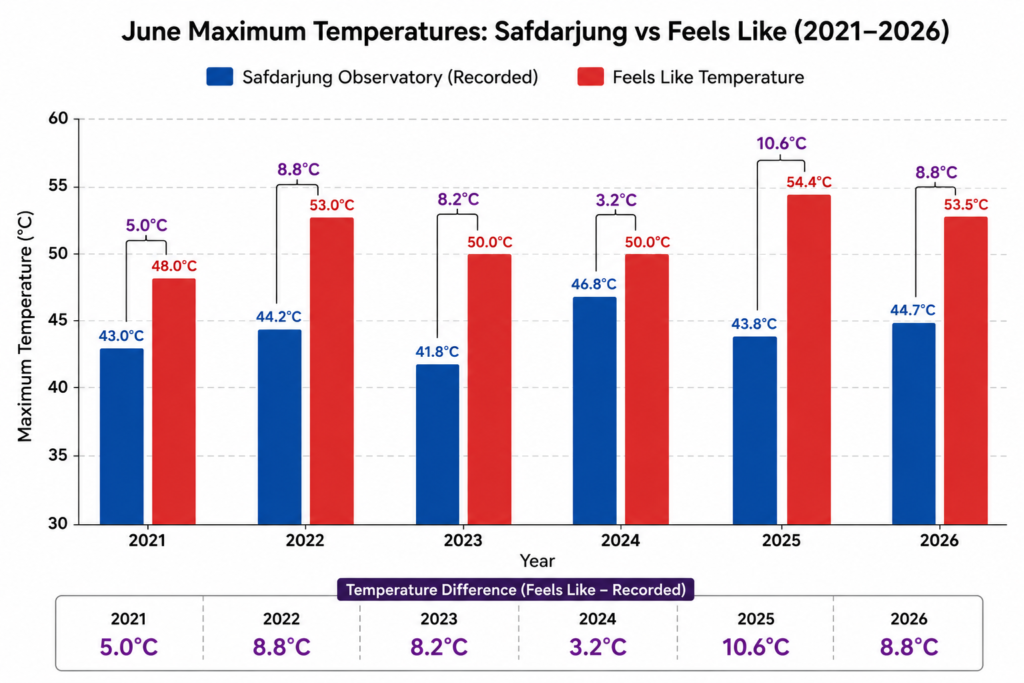
Between 2020 and 2025, Delhi recorded heat-index values ranging from 46°C to 50°C. The heat index is a measure of how hot the temperature actually feels to the human body. On June 30, 2026, Delhi’s heat index touched 53°C even though the actual air temperature was around 37°C. That difference is important for anyone spending hours outdoors.
A thermometer may show 37°C, but for a cyclist sitting in traffic under the sun, the conditions can feel much harsher.
The actual air temperature was also below the India Meteorological Department’s threshold for declaring a heat wave in the plains, which is at least 40°C. [footnoteRef:4]
The number of heat-wave days in Delhi has fluctuated considerably between 2011 and 2026. The highest number was recorded in 2022, with 17 days, followed by 14 days in 2024. While there is no consistent year-on-year increase, extreme heat events have become more intense in recent years. [footnoteRef:5] [footnoteRef:6]
For cyclists, however, even a few hours of extreme heat can make the daily commute difficult.
When asked about the problems they face while riding during summer, the cyclists we interviewed had one common response: extreme exhaustion, particularly between 12 p.m. and 4 p.m. Sunil Singh also spoke about experiencing low blood pressure during this period.
The heat doesn’t stop at traffic signals
For cyclists, Delhi’s traffic jams create another, often overlooked, source of heat. When a cyclist is moving, there is at least some airflow. But when traffic comes to a standstill, they are left surrounded by cars, buses and two-wheelers, often for several minutes at a time.
Cars and particularly buses release hot air from their air-conditioning systems, creating an additional burst of heat for cyclists waiting nearby.
We asked the cyclists to rate how hot and uncomfortable it feels to stand or cycle near vehicles such as buses and cars with their air-conditioning running in traffic. The scale ranged from 1, meaning little or no discomfort, to 10, meaning extreme heat and severe discomfort.
Almost every cyclist rated the experience 10 out of 10. Ravinder Singh rated it 9. Despite the difference in scores, they agreed on one thing, standing beside a bus in traffic is one of the most uncomfortable parts of their journey. This means that for a cyclist, a traffic jam is more than just a delay. It can also mean prolonged exposure to heat at a time when the body is already under physical stress.
When the road itself becomes a source of heat
The heat cyclists experience does not come only from the air. The road beneath them can become much hotter too.
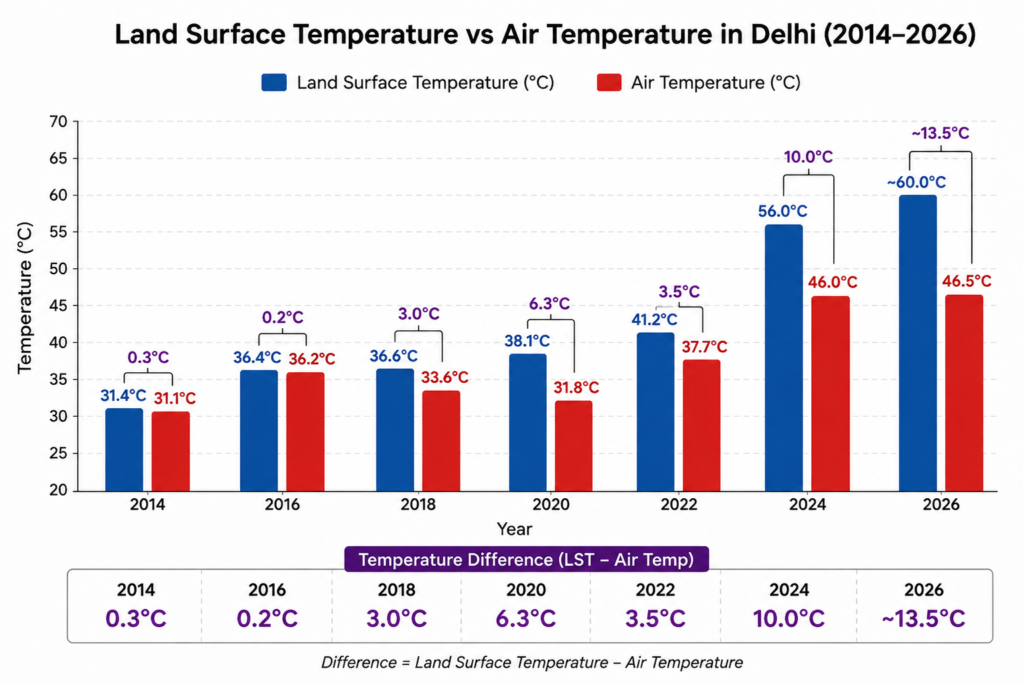
On May 19, Delhi recorded maximum air temperatures of 46.5°C, 45.1°C and 45.5°C across different weather stations. But land-surface temperatures in some parts of the city rose to nearly 60°C, which is around 15°C higher than the recorded air temperature.
The heat also persisted after sunset. The India Meteorological Department recorded Delhi’s warmest night in 14 years, with the minimum temperature settling at 32.4°C—5.7°C above the seasonal normal. That meant little relief for people who had already spent the day outdoors. For cyclists, this combination of hot air and heated roads makes the commute even more demanding.
Is the heat affecting the bicycle too?
The extreme heat may also be taking a toll on bicycles. When asked whether their bicycles and components wear out more quickly during summers, half of the cyclists interviewed said they had noticed their tyres wearing out faster than before.
Ravinder Singh said his bicycle tyres now last only one to two years, compared with five to six years in the past. These are observations from the cyclists themselves rather than a controlled study, but they highlight another possible consequence of prolonged exposure to hot roads.
Asphalt absorbs and retains large amounts of heat from the sun and can become much hotter than the surrounding air. Continuous exposure to these hot surfaces may contribute to faster wear of bicycle tyres and other components.
Cooling down: water, early mornings and small adaptations
Delhi has introduced measures to help people cope with extreme summer heat. The Delhi government operates 85 cooling centres across the city, equipped with coolers, drinking water and other essential facilities. [footnoteRef:10]
The city’s traditional piaus also continue to provide free drinking water to commuters.
For cyclists, these facilities can make a real difference. Rameshwar said he regularly relies on piaus during his commute and found the ones he uses to be well maintained and in good condition.
But cyclists are also adapting their own routines. When asked how they cope with the heat, almost all of them offered the same advice: start the journey earlier.
Leaving earlier helps them avoid the worst of the afternoon heat and, at the same time, reduces the time spent in heavy traffic. Sanjot Singh, Nikhil Singh and Sunil Singh have started leaving for work about an hour earlier than before. Ravinder Singh now begins his commute at 7:30 a.m., compared with 10 a.m. previously.
They also emphasised the importance of drinking enough water and staying hydrated. But changing their routine can only go so far. The bigger question is whether the city itself can change.
Heat is not the only danger on the road
When cyclists were asked about the dangers and challenges they face during summer and how these differ from other seasons, almost all agreed that most problems remain the same throughout the year.
Traffic congestion, nuisance driving by motorists, and cars and two-wheelers encroaching on cycle lanes and footpaths were among their biggest concerns. Summer simply adds another layer to these existing problems.
A cyclist forced out of a cycle lane may have to ride closer to fast-moving traffic. A cyclist stuck at a signal is exposed to heat for longer. And a cyclist travelling on an unshaded road has little protection from the sun.
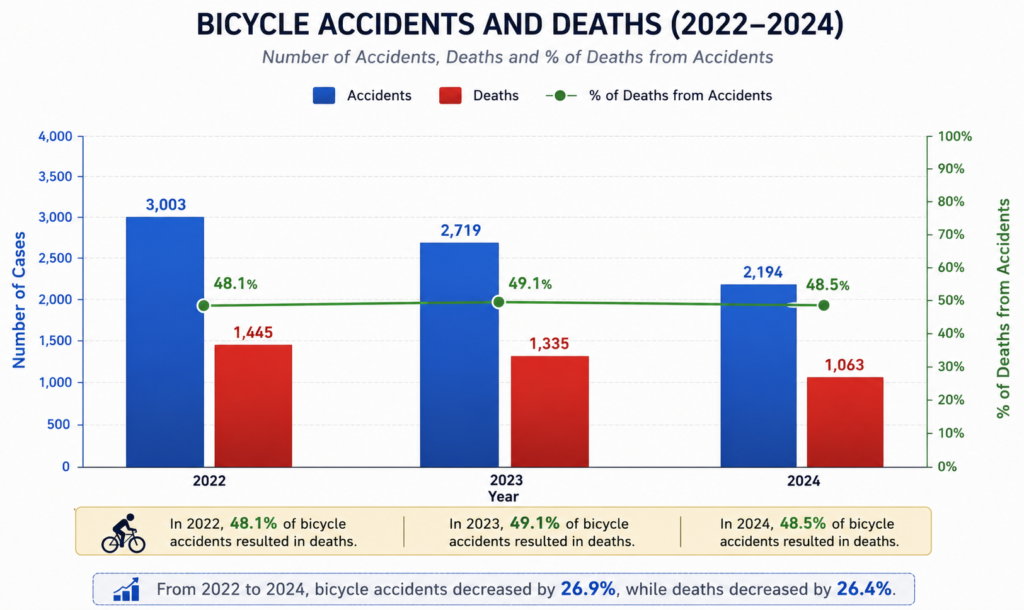
Their concerns are not unfounded. Cyclists remain among the most vulnerable road users in Delhi, with nearly half of all reported bicycle accidents resulting in fatalities.
When cycle lanes disappear
This vulnerability raises another question: has cycling in Delhi become better or worse over the years? All the cyclists interviewed felt that conditions had remained consistently poor.
Ravinder Singh, however, remembered a period when cycling became easier along the Khanpur–Sri Fort stretch after dedicated cycle lanes were introduced.
He also remembers the tree cover along these lanes making the route noticeably cooler.
His observation is supported by temperature measurements showing that roads shaded by trees can be 15–17°C cooler than roads directly exposed to the sun. This makes shaded, green cycle routes more than just aesthetically pleasing—they can also provide cyclists with relief from extreme heat. However, the situation along the route has changed. Ravinder said that ongoing metro construction has affected the cycle lanes, making cycling more difficult.
A striking change can be seen along the Khanpur–Sri Fort stretch. As part of the ongoing construction and road widening, the divider between the main road and the cycle lane has been removed. This has made it easier for cars and motorcycles to enter spaces intended for cyclists and pedestrians.
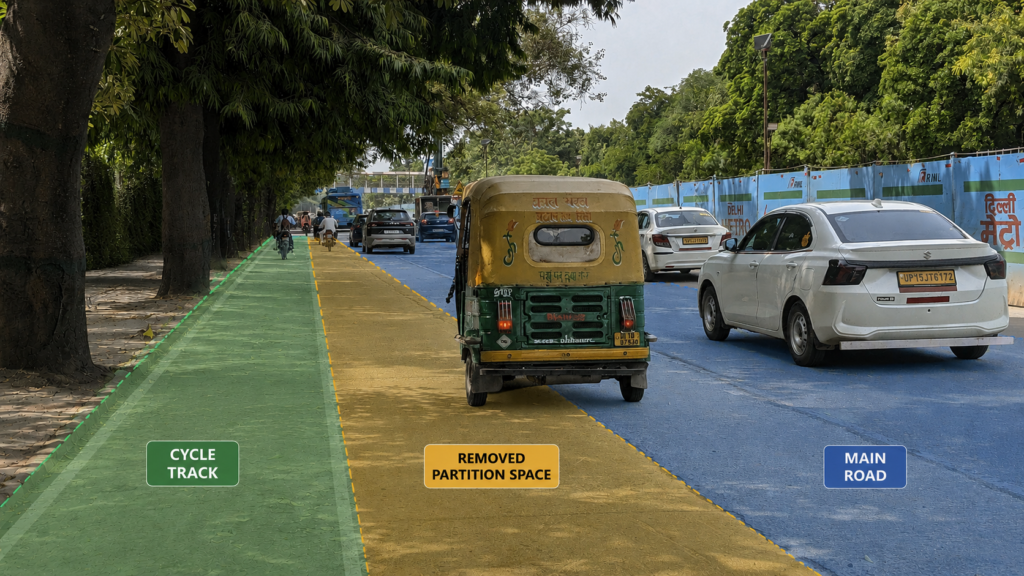
The result is that cyclists have even less protected space on the road. Once again, the tring-tring of bicycle bells is drowned out by the blare of mechanical horns.
The words of American urbanist Lewis Mumford seem particularly relevant here:
“Building more roads to prevent congestion is like a fat man loosening his belt to prevent obesity.”
Widening roads may create more space for vehicles in the short term, but if that space comes at the cost of pedestrians and cyclists, it does little to create a safer or more sustainable transport system.
From compulsion to choice
Today, many people cycle not because they want to, but because they have to. Among the cyclists we interviewed, Ravinder Singh was the only one who said he cycles partly by choice, because he believes it helps him stay healthy. That distinction matters.
If Delhi wants more people to choose cycling as a cleaner and healthier mode of transport, simply asking people to cycle more will not be enough. Cycling has to become safe, practical and comfortable.
That means creating continuous and protected cycle lanes, keeping footpaths and cycle lanes free from encroachment, and providing shade and tree cover along important cycling routes.
It also means ensuring access to drinking water and cooling spaces, particularly along routes used by large numbers of cyclists and pedestrians.
Most importantly, cycle lanes need to be treated as essential transport infrastructure—not as leftover space on the road.
Delhi’s cyclists are already adapting to a hotter city. They are leaving home earlier, carrying water, changing their routes and enduring traffic and heat because they have little choice. The city now needs to adapt to them.
As temperatures rise and congestion grows, more people may need to rely on the simple tring-tring of a bicycle bell instead of the mechanical honk of a motor vehicle. But for that sound to become a bigger part of Delhi’s future, cyclists need more than resilience. They need a city that gives them a safe, shaded and dignified space on the road.
Author: Priyanshu Sharma
Email ID: priyanshusharms26@gmail.com
Read more article on Indian Environmentalism.
So great!!! (Feeling worried about cyclists 🙏)