
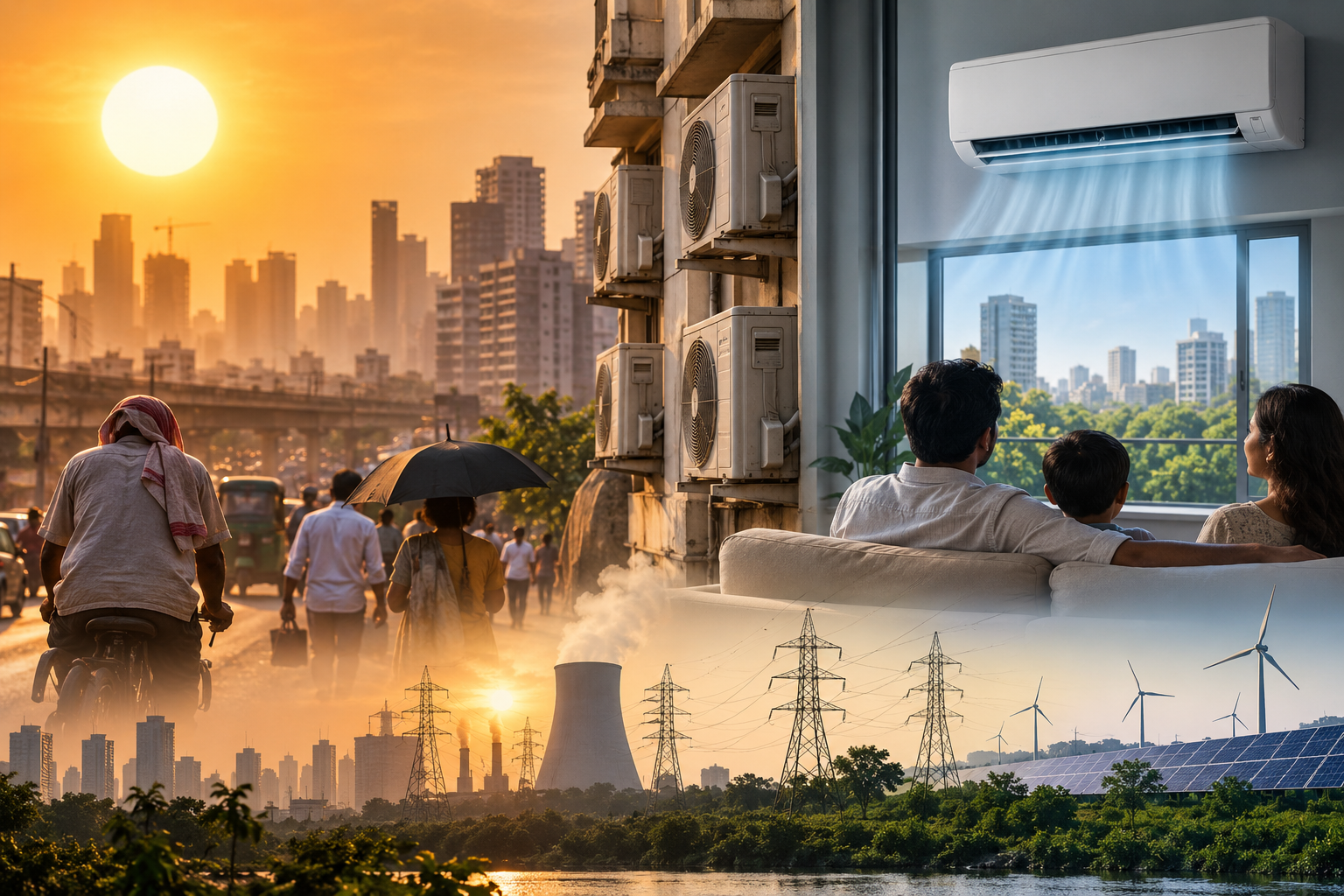
A comprehensive analysis of India’s future of air conditioner amid rising temperatures, air conditioners, energy security, and environmental challenges.
Over the past decade, heat in India has ceased to be merely a seasonal phenomenon and has emerged as a serious national challenge linked to public health, urban planning, energy security, and environmental protection. Heat is no longer confined to the afternoon; nighttime temperatures have also begun to remain higher than before. As a result, it is becoming considerably more difficult for people to find relief naturally.
In such circumstances, the air conditioner (AC) appears to be gradually transforming from a luxury item into a daily necessity. Until a few years ago, having an air conditioner in an Indian household was considered a symbol of economic prosperity. Today, however, it is increasingly being seen as one of the most practical and effective ways to cope with a changing climate. Particularly in metropolitan areas and rapidly developing cities, conditions are emerging where air conditioning is no longer merely a matter of comfort, but is becoming a means of maintaining health and productivity.
However, this change is not limited to individual lifestyles. The growing use of air conditioners also has a profound impact on India’s energy system, environment, and the direction of urban development. Every new air conditioner increases electricity demand, and this demand does not peak during normal periods. Instead, it reaches its highest levels on the very hot days when the power system is already under maximum pressure. A new relationship is therefore emerging between the need for cooling and the availability of energy—one that could create serious challenges in the future if ignored.
There is also an interesting social dimension to this entire discussion. The spread of air conditioners often creates demand for more air conditioners. When a large number of air conditioners are installed in a residential area, office complex, or commercial district, they release the heat from inside buildings into the outside environment. This makes the surrounding outdoor environment even hotter. As a result, even people who previously managed to live without air conditioning may eventually feel compelled to install an air conditioner because of the rising heat. In this way, the problem of cooling begins to take the form of a “Cooling Spiral” or “Cooling Cycle,” in which every new air conditioner further increases the need for another. This is not merely a technological challenge, but also a social and environmental one.
This brings us to a larger question: Can India move towards a future where every household has access to an air conditioner? If so, will the country’s electricity system be capable of bearing this additional demand? Can the rapid expansion of renewable energy meet this requirement, or is the problem not simply one of electricity generation, but also of distribution, energy efficiency, and urban planning? And most importantly, is the solution to rising temperatures simply to install more air conditioners, or do we need to rethink the very way we approach cooling?
This article attempts to find answers to these questions. Its objective is not to argue for or against air conditioners, but to understand by considering India’s climate, energy infrastructure, environmental responsibilities, and developmental realities together—what the most practical, sustainable, and equitable model of cooling for India could be in the years to come.
Rising Demand for Air Conditioners in India: Is It Simply a Result of Economic Growth?
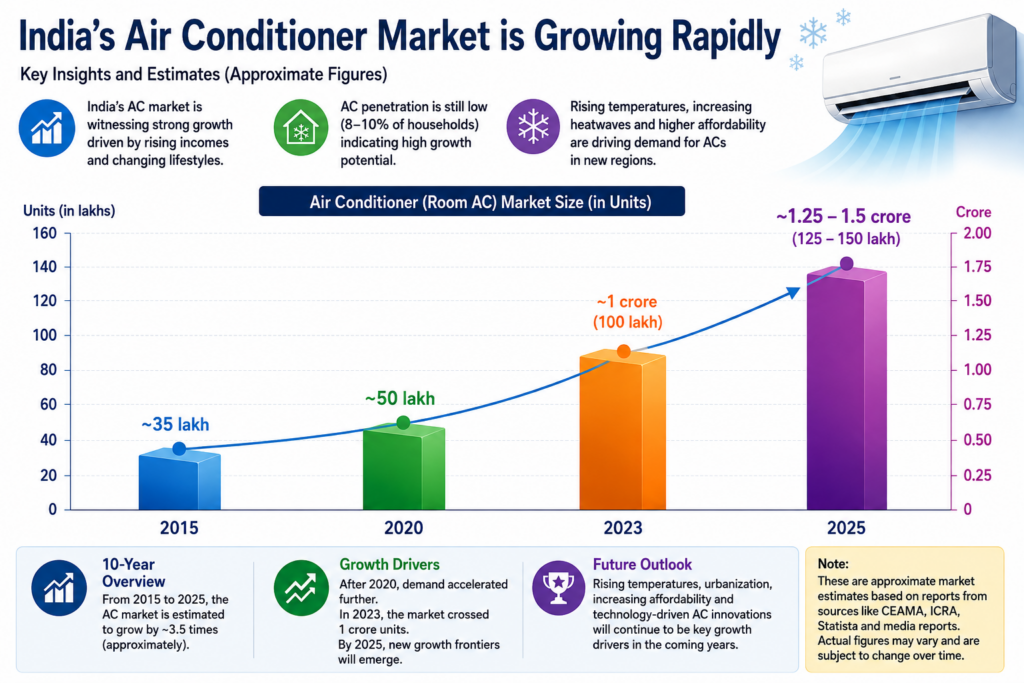
The pace at which air conditioner sales have grown in India over the past decade is not merely a story of an expanding consumer market. It is also a reflection of the broader social, economic, and climatic changes taking place across the country. Until a few years ago, air conditioners were largely limited to higher-income households in metropolitan cities. Today, however, they are rapidly finding their way into homes in smaller cities and among the emerging middle class. Changing lifestyles, rising incomes, easier access to consumer credit, and technological advancements have certainly made air conditioners more affordable than before. However, their growing demand cannot be explained by economic prosperity alone.
The figure above provides a clear indication that India’s air conditioner market has expanded at an unprecedented pace over the past decade. What is particularly noteworthy is that even today, air conditioners are available in only around 8–10 percent of households in the country. At first glance, this percentage may appear low, but in reality, this is precisely what makes it one of the biggest stories about India’s future. It means that the vast majority of the country’s residential market still remains without air conditioning. If per capita incomes rise, urbanisation continues to expand, and the current trend of rising temperatures persists in the coming years, demand for air conditioners could increase several-fold.
This growth is not merely a consequence of rising incomes; it is also a direct consequence of climate change. In recent years, many parts of the country have experienced longer periods of extreme heat, while nighttime temperatures have also begun to remain higher than before. Prolonged periods of extreme heat are becoming increasingly common. In such conditions, fans and traditional cooling methods are no longer as effective as they once were. For people living particularly in high-rise buildings, densely populated urban areas, and concrete-dominated neighbourhoods, air conditioning is gradually becoming a necessity.
There is also a social dimension to this transformation that is rarely discussed. When a large number of people in a city begin using air conditioners, their effects do not remain confined to individual homes. An air conditioner removes heat from the indoor environment and releases it outdoors. As a result, outdoor temperatures around buildings can increase at the local level. This phenomenon has been described in several studies as the Waste Heat Effect. When thousands of air conditioners operate simultaneously in a neighbourhood, apartment complex, or commercial district, the entire local environment can begin to feel relatively warmer.
This is where a kind of “Cooling Spiral” begins. Imagine that only a few families in a neighbourhood install air conditioners. The hot air released by their AC units gradually raises the temperature of the surrounding environment. As a result, families who had previously managed without air conditioning may also begin to experience discomfort. Eventually, they too purchase air conditioners. These additional air conditioners then release even more heat outdoors, creating similar pressure on the remaining households. In this way, demand for air conditioners begins to grow not only because of climate change, but also because of the widespread use of air conditioners themselves. It becomes a kind of self-reinforcing cycle.
This trend becomes even more significant in a rapidly urbanising country like India. The country’s urban population is expected to grow substantially over the next decade. At the same time, high-rise housing, limited open spaces, declining green cover, and concrete-based construction are likely to expand rapidly. Under such conditions, the effectiveness of natural ventilation and traditional cooling techniques may decline, naturally increasing dependence on air conditioning. In other words, future demand for air conditioners will not simply be a consequence of population growth; it will also be a direct consequence of the changing physical form of Indian cities.
Therefore, the real question is not simply why air conditioner sales are increasing in India. The more important question is whether India’s energy system is adequately prepared for this growing demand for cooling. This is why the discussion is no longer merely about the consumer market. It has become a question of energy security, environmental sustainability, and India’s future development model. To understand the rapidly expanding air conditioner market, it is therefore necessary to examine India’s electricity system and its actual capacity to meet this growing demand.
Does India Have Enough Electricity? The Reality Beyond the Numbers
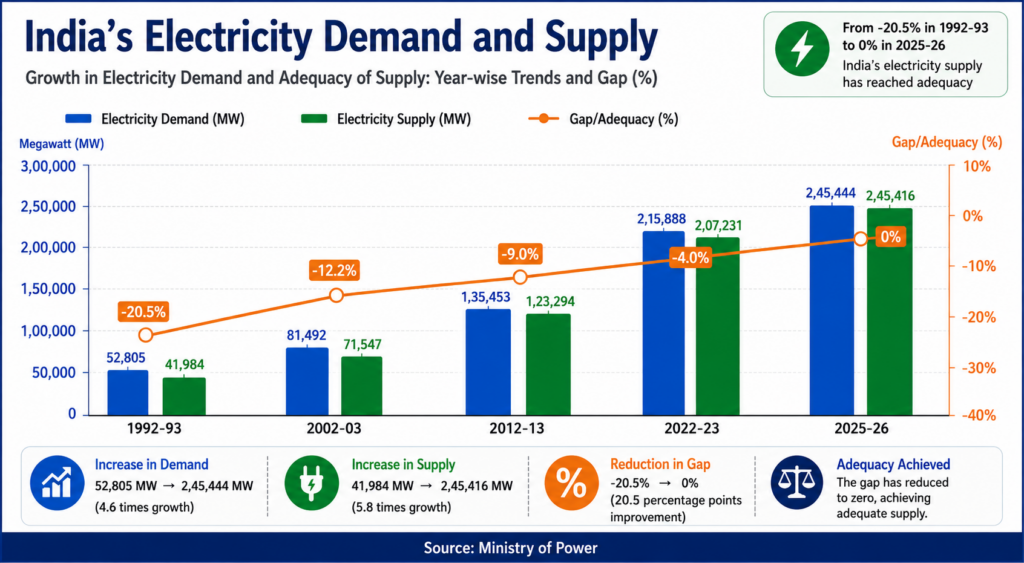
If we look at government data from the past few years, it may appear at first glance that India has made significant progress in the power sector. There was a time when summers were marked by a large gap between electricity demand and available supply. This often resulted in widespread load shedding, power cuts, and restrictions on industries. However, the figure above shows that the gap between Peak Demand and Peak Supply in the country has almost disappeared. At first glance, this appears to be a major success for India’s energy system.
But this is precisely where the greatest caution is required. In the power sector, “zero deficit” and “having sufficient electricity available to everyone at all times” are not the same thing. Without understanding this distinction, it is impossible to properly assess India’s energy system. At the national level, a balance between demand and supply indicates that the country has, overall, developed enough electricity-generation capacity to meet the requirements at a given point in time. But this does not mean that every state, city, and village is receiving electricity with the same quality and reliability. In a vast and diverse country like India, the energy system is not merely a question of generation; it concerns the entire chain through which electricity moves from generation to the final consumer. For this reason, energy experts generally understand the electricity system through four interconnected stages, Generation, Transmission, Distribution and Consumption
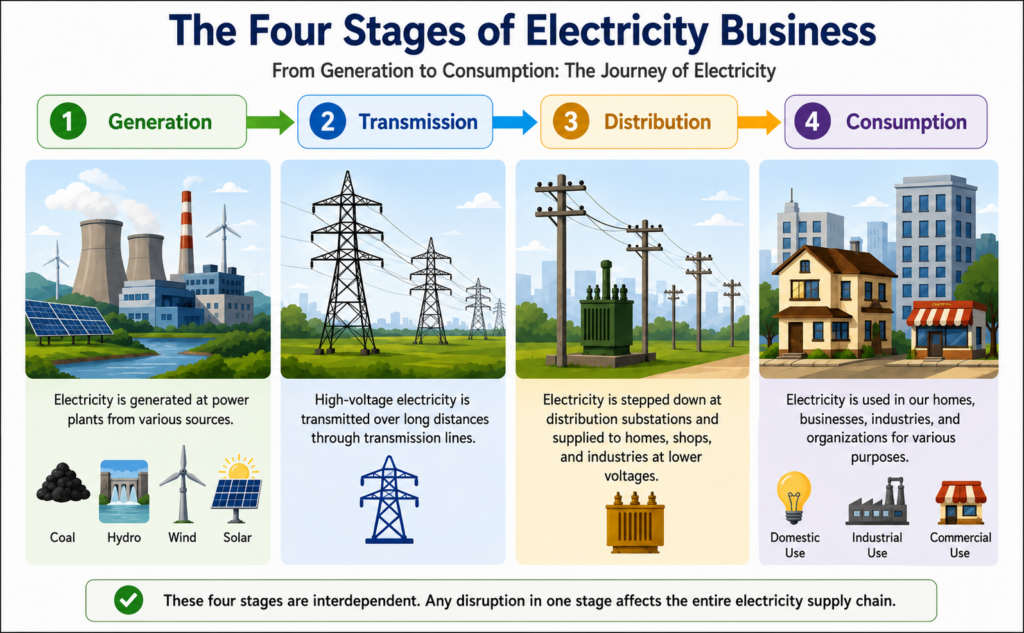
A weakness in any one of these four stages can affect the capacity of the entire system. Therefore, assuming that sufficient generation automatically means reliable electricity supply would be an extreme oversimplification of reality.
Under the Indian Constitution, electricity is a subject in the Concurrent List, meaning that both the Central and State governments play important roles in its functioning. Broadly speaking, a significant portion of generation and the national transmission network falls under the Central Government and its agencies, while distribution and the delivery of electricity to end consumers are primarily the responsibility of state distribution companies (DISCOMs). This is why significant differences in the quality and reliability of electricity supply can exist across states even when sufficient energy is available at the national level.
Another important concept needs to be understood here. India’s Installed Capacity and Actual Generation are not the same thing. No power plant operates at its maximum capacity throughout the year. In thermal power plants, factors such as maintenance, fuel availability, technical constraints, and operational limitations affect generation. Similarly, solar power is available only during the daytime, while wind power depends on wind speeds. Therefore, regardless of how large the installed capacity may be, the actual availability of electricity depends on numerous technical and natural factors. Moreover, India’s per-capita installed electricity capacity remains relatively low, and if a large share of the population begins using air conditioners, the country’s existing installed capacity could prove grossly inadequate to meet the resulting demand.
Over the past decade, India has significantly expanded its electricity-generation capacity and has also established a strong presence globally in the renewable-energy sector. This achievement is undoubtedly important. However, it is equally important to understand the fundamental difference between greater availability of electricity and unlimited availability of electricity. As the number of air conditioners increases, electricity demand during the summer will rise extremely sharply within a few peak hours. The challenge for the energy system is therefore not simply to provide electricity throughout the year, but to maintain reliable supply during those few hours when millions of people simultaneously require cooling.
This is why the discussion around air conditioners cannot be limited to electricity generation alone. If tens of millions of new air conditioners are added in the future, the question will not merely be how much electricity the country can generate. It will also be whether our distribution networks, local grids, transformers, and urban electricity infrastructure are prepared to safely and reliably handle this additional load.
To understand this question, it is now necessary to examine each stage of India’s electricity system—generation, transmission, distribution, and consumption—separately. The future of both India’s cooling system and its energy security will depend on these four pillars.
The Four Pillars of India’s Electricity System: Is Generating More Power Enough?
Electricity Generation
Whenever electricity is discussed in India, most people tend to focus only on electricity generation. The common assumption is that if the country starts generating more electricity, most energy-related problems will automatically disappear. But the reality is far more complex. Generation is only the first stage of the entire system. If the rest of the system is weak, reliable electricity may still fail to reach the end consumer despite having sufficient generation capacity.
Over the past decade, India has made significant progress in expanding its electricity-generation capacity. Today, the country is among the world’s largest electricity producers and has also emerged as one of the leading countries in renewable energy. The rapid expansion of solar and wind power indicates that India is seriously moving towards a transition from conventional energy sources to cleaner energy.
However, it is important to understand that Installed Capacity and Firm Power are not the same thing. No electricity system can continuously operate at 100% of its installed capacity. Thermal power plants require periodic maintenance, fuel availability can affect generation, while sources such as solar and wind depend on natural conditions. Solar power is unavailable after sunset, while wind generation fluctuates with weather conditions.
Therefore, while the numbers clearly show that India has made significant progress in renewable energy, coal-based thermal power plants still form the backbone of the country’s electricity system. A large share of India’s electricity generation continues to come from coal because, under current conditions, it remains one of the most capable sources of providing continuous firm power at the scale required to match demand.
Transmission: One of India’s Major Successes
If one part of India’s power sector can be described as one of its greatest achievements over the past two decades, it is the national transmission system. Today, India’s One Nation, One Grid model is regarded as one of the world’s largest interconnected electricity networks. It allows electricity generated in one part of the country to be transmitted to another part relatively quickly when required.
The expansion of renewable energy has also benefited significantly from this strong grid. Electricity generated by solar power plants in Rajasthan or wind-energy regions in Gujarat and Tamil Nadu can now be transmitted to distant states far more easily than before. This is one of the reasons why electricity availability at the national level has improved significantly.
However, a stronger transmission network does not mean that the challenge of delivering electricity to the final consumer has been solved to the same extent. Reaching the national grid and providing reliable, high-quality electricity to every household are two different stages. This distinction brings us to the distribution system.
Distribution: The Weakest Link in India’s Electricity System
If one had to identify the most challenging part of India’s energy system, it would undoubtedly be distribution. This is the level at which national achievements often translate into local problems.
Distribution companies (DISCOMs) in several states have been under financial pressure for years. In many places, basic electricity-distribution infrastructure—including transformers, feeders, and local distribution lines—has not expanded quickly enough to keep pace with rising demand. As the number of air conditioners, electrical appliances, and eventually electric vehicles increases in cities, these local networks will be among the first parts of the system to come under pressure.
This is perhaps the biggest paradox in India’s electricity system: in many cases, the problem is not a shortage of electricity, but the ability to reliably deliver electricity to the final consumer. During summer, when thousands of air conditioners in a city switch on simultaneously, local transformers and distribution lines can suddenly face extremely high loads. This can result in voltage drops, repeated power interruptions, or even damaged transformers in some areas.
Distribution is not merely a technical challenge; it is also an economic and political challenge. In several states, electricity tariffs are kept below the actual cost for social and political reasons. Subsidies provided to agricultural and domestic consumers may be socially necessary, but they also affect the financial health of distribution companies. When DISCOMs lack sufficient resources, their ability to invest in new transformers, modernise distribution networks, and carry out maintenance is also constrained.
This is why, despite significant growth in electricity generation, consumers in many parts of India still do not experience uninterrupted and high-quality power supply.
Consumption: Not Just About Availability, but Also How Electricity Is Used
In India’s electricity system, the consumer is not merely the final user; the consumer is an important component of the entire energy system. Just as generation, transmission, and distribution matter, the pattern of consumption also determines how effective and sustainable the system can be.
India’s challenge is therefore not simply to make sufficient electricity available, but also to ensure that the electricity available is used in accordance with established standards and regulations.
One of the biggest problems associated with electricity consumption today is the gap between Sanctioned Load and Actual Load. Many consumers use significantly more electrical load in practice than the capacity for which they have taken a connection. Continuous operation of high-capacity electrical appliances on domestic connections places additional pressure on local distribution infrastructure. When large numbers of consumers in an area use electricity beyond their sanctioned limits, transformers and distribution lines can be forced to operate beyond their designed capacity, leading to repeated faults, voltage fluctuations, and equipment damage.
Another serious challenge is the blurring of the distinction between domestic and commercial use. In many places, domestic electricity connections are used for small industries, shops, offices, warehouses, or other commercial activities. Since electricity tariffs differ between domestic and commercial categories, such use not only affects the revenues of distribution companies but also distorts estimates of actual electricity demand. This, in turn, creates difficulties in planning distribution networks and determining the required capacity expansion.
Similarly, the uncontrolled use of personal voltage stabilisers and other private electrical devices represents another distinctive problem within India’s electricity system. Millions of consumers use stabilisers and additional electrical equipment to protect themselves against voltage fluctuations. While these provide an individual-level solution, they also indicate that the quality of the distribution system is still not equally reliable across all regions.
These technical challenges are accompanied by an important political-economy dimension. Electricity in India is not merely an economic commodity; it is also a sensitive social and political issue. Decisions regarding electricity tariffs, subsidies, subsidised connections, and bill collection are often influenced by political priorities across states. As a result, enforcing strict action against unauthorised loads, misuse of electricity categories, or electricity theft can sometimes be administratively and politically difficult. This creates a clear gap between effective enforcement of regulations and consumer discipline.
The consequences extend beyond the financial health of DISCOMs. When there is a gap between actual electricity demand and recorded demand, it also affects decisions regarding future generation planning, transformer capacity, feeder design, and local grid expansion. In other words, small irregularities at the consumer level can ultimately affect the efficiency of the entire electricity system.
There is another important dimension to India’s energy system: over time, electricity is becoming not merely one source of energy, but a common energy platform shared by almost every major energy system. Transport, household energy, industrial production, digital infrastructure, and communications are all becoming increasingly dependent on electricity. Particularly when the prices of conventional energy sources such as petrol, diesel, or LPG rise, their supply is disrupted, or policies are introduced to reduce their use, energy demand naturally begins shifting towards electricity. Electric vehicles, induction cooktops, heat pumps, electric boilers, and other electrical appliances are examples of this transition.
From this perspective, electricity is no longer simply a commodity for consumption. It has become one of the most important pillars of national energy security. If dependence on fossil fuels declines in the future, the energy requirements of transport, cooking, cooling, and many industrial processes will increasingly shift onto the electricity system. In other words, electricity must now be viewed not as the requirement of any single sector, but as the “backbone energy” of the entire economy. This is why the reliability, capacity, and efficiency of the electricity sector are no longer matters for the Ministry of Power alone; they are increasingly linked to India’s broader energy, economic, and strategic security.
India’s energy challenge, therefore, is not limited to generating more electricity or improving distribution. Responsible consumption, adherence to sanctioned loads, appropriate categorisation of electricity use, and energy discipline are equally important. Unless the consumption system becomes more transparent, accountable, and rules-based, it will be difficult to realise the full benefits of the large investments being made in the electricity sector.
Ultimately, India’s real challenge is not simply electricity generation, but the overall capacity of its energy system. The country has made significant progress in generation and in building a national grid, but distribution, local infrastructure, and rising consumption demand will be the biggest tests of the future. If the number of air conditioners continues to grow at its current pace, simply building new power plants will not be enough. India will need to develop an energy system capable of handling growing cooling demand safely, reliably, and sustainably at every level—from generation to the final consumer.
The Rise of Renewable Energy: Can Clean Energy Meet India’s Growing Cooling Demand?
If we look only at the past decade, the pace at which India’s energy sector has transformed is remarkable even by global standards. There was a time when India’s energy policy was centred largely around coal-based electricity generation. Today, however, the country has emerged as one of the world’s leading nations in solar and wind energy. This transformation is not merely an effort to increase electricity generation; it is part of a broader strategy to balance energy security, climate change, and sustainable development.
According to the International Renewable Energy Agency (IRENA), India currently ranks third in the world in solar power capacity, fourth in wind power, and third in total installed renewable energy capacity. These achievements are not limited to rankings; they indicate that India is playing an increasingly important role in the Global Energy Transition. The rapid growth of solar capacity and the expansion of wind power over the past decade provide a clear picture of this transformation. During the same period, India also reached a point where, for the first time, more than half of the country’s total electricity demand on a single day was met by renewable sources. This was not merely a symbolic achievement; it demonstrated that clean energy has become an important part of India’s electricity system.
However, while understanding this success, it is equally important to understand its limitations. The biggest advantage of renewable energy is that it is clean, relies on local resources, and can reduce dependence on fossil fuels over the long term. But its biggest challenge is that it is a variable energy source. Solar energy is available only during the daytime, and its output depends on cloud cover and weather conditions. Similarly, wind power fluctuates according to wind speeds. Air-conditioning demand, on the other hand, does not follow nature; it follows human needs.
This brings us to one of the most important questions in energy policy: Can simply installing more solar capacity meet the future demand for air conditioning? The answer is not straightforward. Expanding renewable energy generation is necessary, but it must be accompanied by the development of energy storage, battery technology, pumped-hydro storage, smart grids, demand-side management, and energy-efficient appliances. If progress in these areas does not keep pace, simply increasing installed capacity will not be enough to solve the energy challenges of the future.
This is why India’s energy policy is not limited to large power plants. In recent years, the government has also placed considerable emphasis on the decentralisation of energy. Through the PM-KUSUM scheme, efforts have been made to turn farmers from merely electricity consumers into energy producers. The solarisation of agricultural pumps, small grid-connected solar plants, and mechanisms for selling surplus electricity to the grid have introduced a new approach to the rural energy model. Similarly, through the PM Surya Ghar: Muft Bijli Yojana, solar power systems are being installed on the rooftops of millions of households. The objective is not only to reduce electricity bills, but also to make electricity generation in urban areas more decentralised and self-reliant.
India’s role is not limited to the domestic level. At the international level as well, the country has established itself as a leader in clean energy. The establishment of the International Solar Alliance, active participation in Mission Innovation and the Clean Energy Ministerial, and the ‘Panchamrit’ commitments presented at COP26 demonstrate that India views addressing climate change not merely as a national responsibility, but as a global one. Achieving its 2030 target for non-fossil fuel energy capacity ahead of schedule is another indication of this commitment.
Yet, despite all these achievements, it would not be appropriate to conclude that India has now reached a position where it can provide unlimited energy. In reality, renewable energy has certainly increased India’s energy capacity, but the future challenge is not only about the amount of electricity generated; it is also about the demand profile. If tens of millions of new air conditioners, electric vehicles, data centres, and digital infrastructure simultaneously increase electricity demand in the coming years, the energy system will need to provide not simply more electricity, but sufficient electricity at the right time and in the right place.
This is why the energy transition of the future is not simply a transition from “coal to solar.” It is a transition from centralised generation to decentralised energy, from unlimited consumption to energy efficiency, and from simply producing electricity to managing the energy system as a whole. If this broader approach is adopted, renewable energy can provide a sustainable foundation for meeting India’s growing cooling requirements. But if the energy transition is reduced merely to figures for installed capacity, the growing culture of air conditioning could once again place serious pressure on the electricity system in the future.
It is therefore clear that India has made remarkable progress in clean energy and is also helping shape a new direction for the world. But in an era of rising temperatures, true success will not come simply from generating more electricity. It will come from developing an energy system that is clean, reliable, and capable of meeting the country’s growing cooling needs without placing an additional burden on the environment.
Is the Air Conditioner Really the Future? The Path to Sustainable Cooling for India
The discussion so far makes it clear that air conditioners are not the root of the problem. In a warming climate, every person has the right to live safely and comfortably, and if an air conditioner becomes a means for a family to maintain its health, productivity, or quality of life, it cannot simply be dismissed as a luxury. The real question is not why people are buying air conditioners, but whether our development model is moving in a direction where every new problem is addressed simply by turning to machines that consume more electricity.
This is where India needs to understand the fundamental difference between Cooling and Air Conditioning. Air conditioning is only one means of providing cooling; it is not cooling itself. If a building is designed in a way that allows adequate natural ventilation, uses walls and roofs that absorb less heat, has green spaces around it, and limits direct exposure to sunlight, its temperature can be reduced significantly without additional energy consumption. In other words, the cheapest and cleanest energy is the energy that is never needed in the first place.
Ironically, a large part of modern Indian cities has developed in exactly the opposite direction. Traditional Indian architecture evolved over centuries in response to local climatic conditions. Thick walls, high ceilings, courtyards, jaalis, overhanging shades, verandas, and locally available materials such as mud and stone were not merely aesthetic choices; they also served the purpose of natural cooling. Today, these features are increasingly being replaced by glass-covered high-rise buildings, concrete surfaces, and highly dense urban areas. As a result, buildings themselves are beginning to store more heat, increasing dependence on air conditioners to escape that very heat. This creates a kind of energy-dependent development cycle, in which building design itself generates additional energy demand.
This is why Passive Cooling—controlling indoor temperatures without mechanical systems is once again receiving greater attention around the world. It includes measures such as Cool Roofs, reflective paints, better insulation, natural ventilation, shade-providing trees, preservation of water bodies, and climate-responsive building design. Their importance extends beyond environmental benefits. If a building’s temperature can naturally be kept 2–4°C lower, both the need for air conditioning and its electricity consumption can be significantly reduced. In other words, these solutions reduce energy demand before we even need to increase electricity generation.
Urban planning is another extremely important part of this discussion. India’s urban population is expected to grow rapidly in the coming years. If new cities and residential projects continue to be developed according to the same energy-intensive model, controlling future demand for air conditioners will become extremely difficult. Therefore, when planning cities, green spaces, tree preservation, restoration of water bodies, adequate spacing between buildings, and climate-responsive construction standards should not be treated merely as environmental choices; they should also be considered part of energy policy.
The Government of India has also begun taking some important steps in this direction. To promote energy-efficient appliances, the BEE Star Rating system has been introduced, encouraging the use of air conditioners that consume less electricity. In addition, proposed standards regarding keeping air-conditioner temperatures no lower than 20°C and no higher than 28°C are part of the same broader approach. The objective is not to reduce people’s comfort, but to limit unnecessary energy consumption. Even operating air conditioners at a temperature just one or two degrees higher can potentially reduce electricity demand significantly at the national level.
India today stands at a point where climate change, rapid urbanisation, and economic development are bringing both new challenges and new opportunities. As temperatures rise, growing demand for air conditioners is natural, and treating it merely as a consequence of consumerism or luxury would mean ignoring reality. In the coming years, hundreds of millions of Indians will aspire to better living standards, including access to cooling—and that aspiration is entirely legitimate.
But fulfilling this aspiration cannot be limited to selling more air conditioners or generating more electricity. If growing cooling needs are not integrated with energy-efficient buildings, climate-responsive urban planning, renewable energy, smart grids, energy storage, and responsible consumption, the same air conditioners that provide relief from heat today could become a source of unbearable pressure on the electricity system and create new challenges for the climate in the future.
India has made significant progress in clean energy and has established itself as a leader on the global stage. The next phase, however, is not simply about generating more energy; it is about using energy intelligently. The future will belong to a society that does not merely generate more electricity, but also reduces the amount of electricity it needs.
Therefore, the real question facing India is not “Will every household have an air conditioner?” It is: “Can every household be made comfortable without placing an additional burden on the environment and the energy system?” If we succeed in answering this question, India will not only be better equipped to confront rising temperatures, but could also present the world with a new development model for Sustainable Cooling.
Read more such articles on Indian Environmentalism